


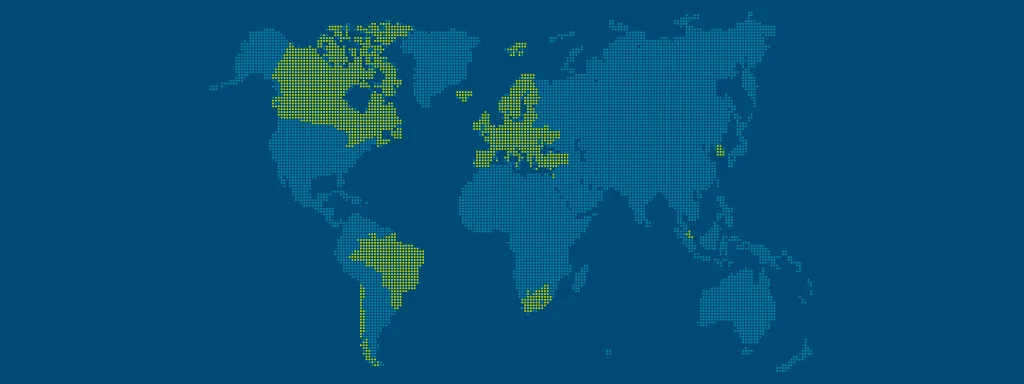
Research, technology, and innovation are key to international competitiveness. With its flexible support and funding opportunities for companies and scientific institutions, Eureka makes a significant contribution to this. What began in 1985 as a purely European initiative is now a global network: ministries and funding agencies from 47 countries and the European Commission work together in Eureka.
The Eureka network supports companies and scientific institutions in cross-border and market-oriented projects in all areas of technology. Eureka offers a wide range of programmes for this purpose. What makes it special is that, when it comes to activities such as new calls for proposals, each country decides for itself whether and to what extent it will participate.
Which countries are represented in the Eureka network?
Currently, 47 countries and the European Commission are represented in the Eureka network. In addition to all 27 member states of the European Union, these include: Albania, Bosnia and Herzegovina, Brazil, Canada, Chile, Iceland, Israel, Monaco, Montenegro, North Macedonia, Norway, San Marino, Serbia, Singapore, South Africa, South Korea, Switzerland, Ukraine, Turkey, and the United Kingdom.
Germany is one of the founding members of Eureka. It is represented in the Eureka network by the Federal Ministry of Research, Technology and Space (BMFTR).